

Step out into the dawn air of any city, town, or rural alley in Vietnam, and your senses are greeted by an identical, intoxicating signal. You can smell and see the morning Pho.
Before the tropical sun clears the rooftops, through the blue morning mist and the low hum of early mopeds, a thick plume of steam billows from an enormous aluminum stockpot on the sidewalk. With that steam comes a fragrance that words can barely capture: the deep, rich savor of marrow bones simmered past the point of surrender, laced with the sweet, licorice-warmth of charred star anise, cinnamon, toasted ginger, and roasted shallots.
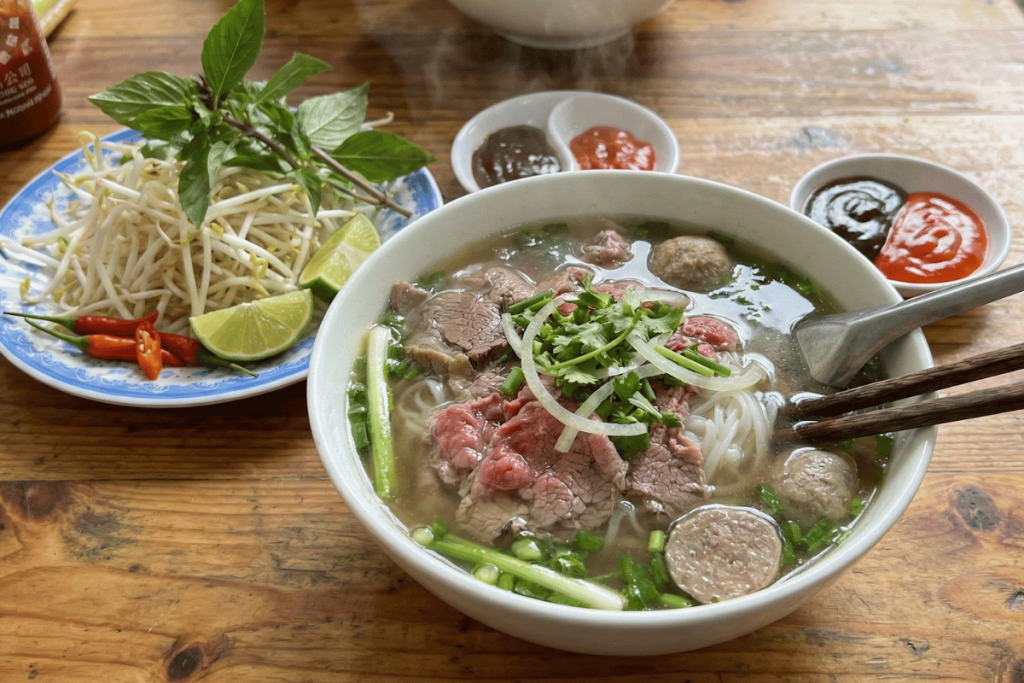
Why Morning Pho is a Sacred Ritual, Not Fast Food
Look around, and you will see the heartbeat of the morning unfold. On miniature, knee-high blue and red plastic stools clustered on the cracked tile pavement, a crowd sits huddled over porcelain bowls.
Here, there are no social boundaries. A corporate executive in a bespoke suit sits elbow-to-elbow with a cyclo driver wiping sleep from his eyes. Schoolchildren in crisp white uniforms slurp noodles alongside grandmothers in floral cotton pajamas. Everyone is leaning forward, chopstick tips lifting glistening folds of flat rice noodles, soup spoons cradling broth so clear it catches the early sunlight, their faces bathed in the soothing heat of the bowl.
Pho has conquered the modern world. You can find it today in sleek eateries in London, trendy dining hubs in Sydney, strip malls in California, and bustling corners of Paris. Often, it is categorized loosely under the banner of “quick-service Asian food” or treated as a comforting lunch or late-night hangover cure.
To encounter pho in Vietnam, however, is to realize that it is neither fast food nor casual fare. It is an intentional, deeply reverent morning ritual. It is a slow, generational craft passed down like a family heirloom—an unhurried labor of love that transforms discarded bones and colonial collision into the foundational fuel of an entire nation.

The Illusion of “Fast”: The Ten-Hour Simmer Behind a Two-Minute Serve of Pho
The great paradox of pho is how rapidly it arrives at your table.
You pull up a tiny stool, catch the eye of the cook, whisper “Một tái nạm” (one bowl with rare steak and flank), and before you have unwrapped your chopsticks from their paper sleeve, the steaming bowl lands in front of you with a decisive clatter. Two minutes, start to finish. To the untrained eye, it looks like fast food.
In reality, that two-minute bowl is the culmination of ten to twelve hours of unbroken culinary patience.
Pho is not whipped up to order. While you were sleeping at 9:00 PM the night before, the street vendor—usually a matriarch who has operated the same patch of sidewalk for three decades—was already hard at work over a glowing burner.
Making authentic, soulful pho broth is an exacting science disguised as intuition. It is notoriously difficult, unforgiving, and physically grueling:
- The Purge and Blanch: You cannot simply throw beef marrow bones and knuckles into water and walk away; doing so yields a cloudy, bitter broth. The vendor must repeatedly scrub the bones, soak them in salt and vinegar to draw out impurities, blanch them in boiling water, discard that dirty initial water, and wash every single bone by hand until clean.
- The Gentle, Flame-Kissed Simmer: Only then do the bones go into the massive stockpot with fresh, filtered water. The heat must never roar. A rolling boil will emulsify the fat and turn the broth murky. It must remain at a bare tremble—a delicate, steady murmur just below the surface—for ten to fourteen hours.
- The Extraction of Collagen: Over those nocturnal hours, the tough connective tissue slowly breaks down into gelatin. The marrow inside the heavy femur bones melts out into microscopic droplets of rich fat that will eventually float like tiny golden jewels atop the soup.
- Charring the Aromatics: While the bones simmer, the aromatics are transformed over open fire. Thick pieces of ginger and purple shallots are placed directly on hot coals or an open flame until their skins blacken and blister into fragrant charcoal. The charred, papery skins are scraped away, exposing tender, deeply caramelized centers that impart smoky complexity and natural sweetness without adding sugar.
- The Spice Balance: Whole star anise, sticks of cassia bark, black cardamom pods (thảo quả), coriander seeds, and fennel seeds are toasted in a dry skillet until their essential oils awaken, then tied inside a cheesecloth bundle and submerged into the pot during the final hours of simmering. Too long, and the spices dominate the meat; too short, and the broth lacks dimension.
By 4:30 AM, while the city is still enveloped in quiet darkness, the vendor removes the spice sachet, skims the foam from the surface, and balances the liquid with pure sea salt and splashes of amber fish sauce (nước mắm).
When you sit down at 6:30 AM, that clear, glistening amber broth is a captured distillation of time itself. It is liquid patience.

From Colonial Scraps to National Icon: A History of Collision and Invention of Pho
Pho feels ancient, but it is a creature of the early 20th century—born from the dramatic cultural and economic collisions of French colonial occupation, Chinese merchant migration, and Vietnamese culinary ingenuity.
Before the arrival of the French in Indochina in the late 19th century, beef was rarely consumed in Vietnam. Water buffalo and yellow cattle were precious, revered agricultural animals used for pulling plows and hauling rice in the muddy paddies. To slaughter a healthy draft beast for meat was considered deeply wasteful, if not taboo.
The French colonists, however, demanded the familiar steaks and roasts of home. French butchers set up shop in Hanoi and Nam Dinh, slicing out prime loins and sirloins for European tables and leaving behind mountains of “undesirable” cuts: giant marrow bones, knuckles, ox tails, brisket, and flank.
Vietnamese cooks, possessing a generational genius for waste-nothing resourcefulness, saw pure treasure in those discarded bones.
In the working-class industrial town of Nam Dinh, south of Hanoi, textile mill workers toiled long hours beside the Red River. Chinese hawkers walked the streets with shoulder poles (đòn gánh), balancing a charcoal stove on one side and bowls, noodles, and broth on the other. They sold an early predecessor called ngưu nhục phấn (beef noodle soup).
Over time, local street cooks synthesized these elements:
- The French Foundation: The slow, clear-simmered beef bone stock echoed the French pot-au-feu (beef stew), utilizing charred root vegetables and slow extraction.
- The Chinese Influence: The presence of warm, five-spice aromatics like star anise, cassia, and black cardamom, alongside flat rice noodles.
- The Vietnamese Soul: The essential pivot to pungent, fermented fish sauce instead of soy sauce, accompanied by fresh scallions, culantro, and herbs grown in the moist subtropical soil.
Even the linguistic origins of the word phở remain a spirited debate among historians. Some argue it was derived from the French feu (fire, from pot-au-feu); others point to the Cantonese phấn (rice noodles).
Regardless of its exact linguistic root, pho was forged in the foundries of working-class survival. It was a dish born out of taking the cast-offs of an occupying power and refining them into a masterpiece of local identity.

North vs. South: The Great Bowl Divide and Pho
As pho traveled across the geography of Vietnam, it splintered into two distinct, fiercely defended cultural philosophies: Phở Bắc (Northern style) and Phở Nam (Southern style).
Phở Bắc: The Art of Pure Restraint
In Hanoi, pho is an exercise in minimalist purity.
A Northern bowl arrives unadorned by foliage. You will not find heaps of bean sprouts, hoisin sauce, or fresh herbs floating in the soup. The broth is exceptionally clear, delicately seasoned, and intensely focused on the pure, unadulterated flavor of beef marrow and toasted ginger.
The only greenery permitted is a heavy blanket of thin, pungent scallions (hành lá) and tender cilantro stems chopped fine, floating over flat, wide, slippery hand-cut noodles. The only permissible condiments on the wooden table are a jar of raw garlic steeped in white rice vinegar (dấm tỏi), a few bird’s-eye chilies, fresh lime wedges, and a bottle of bright red chili sauce made by the vendor herself.
To dump sweet brown hoisin sauce into a bowl of Northern pho is seen by local elders as an insult to the broth’s nuance. You take a sip of the pure broth first. You taste the water, the bone, the salt. You add two spoonfuls of pickled garlic vinegar to cut the rich fat, and you eat alongside a pair of quẩy—crispy, golden fried crullers that you dunk directly into the broth to soak up every last drop.
Phở Nam: The Garden of Abundance
Following the partition of Vietnam in 1954, over a million Northerners migrated south to Saigon, taking their pho carts with them. In the fertile, sun-drenched Mekong Delta and southern plains, the soup adapted to the region’s tropical abundance and diverse trade influences.
A Southern bowl of pho is a celebration of extravagance. The broth is sweeter, often simmered with rock sugar and charred daikon radish, darker in hue, and spiced more heavily with cloves and star anise.
Before your bowl even arrives in Ho Chi Minh City, the table is dominated by a giant, overflowing wicker basket of raw greens:
- Purple-stemmed Thai basil (húng quế).
- Sawtooth herb / culantro (ngò gai).
- Pungent rice paddy herb (ngò ôm).
- Raw, crunchy bean sprouts (giá).
On the table sit twin squirt bottles of dark, sweet hoisin sauce (tương đen) and spicy chili paste (tương ớt). Southerners tear bunches of fresh herbs with their hands, bruise them between their fingers to release the volatile oils, push them beneath the noodles to wilt in the scalding broth, and squeeze swirls of hoisin and chili directly into the bowl or into a small dipping saucer for the meat.
Neither version is “wrong.” The Northern bowl is poetry written with four words; the Southern bowl is an epic novel told with forty. Both represent the terrain, temperament, and history of their people.

Why Morning? The Pacing of a Vietnamese Day and Pho
To understand why pho belongs to the dawn, you have to understand how life moves in Southeast Asia.
Vietnam is a country that wakes early. By 5:30 AM, parks around West Lake in Hanoi or Tao Dan Park in Saigon are already humming with life: badminton games in the mist, elders practicing Tai Chi, and groups clapping in cadence to morning aerobics. The cool, quiet morning window is precious; by 10:00 AM, the heat and tropical humidity can be oppressive.
Pho is the quintessential morning meal because it solves every metabolic need of a hard-working population:
- Gentle, Restorative Digestion: The long-cooked bone broth is packed with electrolytes, amino acids, and soothing gelatin. It is light on a waking stomach, hydrating after a humid night, yet deeply nourishing.
- Sustained Energy: The simple carbohydrates of steamed rice flour noodles provide immediate energy, while the thin slices of beef—whether tender, well-done brisket (chín) or flash-poached raw tenderloin (tái)—give slow-burning protein that sustains physical labor through the midday heat.
- The Warming of the System: In traditional Vietnamese medicine, heavily influenced by Sino-Vietnamese humoral concepts of yin and balance, the human body needs warming after sleep. The ginger, black cardamom, and hot soup stoke the digestive fire, shaking off the dampness of the morning fog.
By 9:30 or 10:00 AM, the best street stalls are scraping the bottom of their stockpots. Once that batch of broth is gone, service is finished for the day. If you show up at noon looking for pho at a traditional roadside vendor, you will find only rinsed plastic stools stacked up against a closed metal shutter, and a grandmother sweeping up lime wedges and used napkins.

The Sidewalk as Living Room: The Plastic Stool Democracy and Pho
Beyond the culinary mastery, morning pho holds an essential sociological role: it is the town square of Vietnamese public life.
In dense cities where families often live in multi-generational tube houses, homes are private, vertical sanctuaries. The sidewalk, by contrast, is the communal living room.
Sitting on a tiny plastic stool lowers your center of gravity. It brings everyone down to the exact same physical level. There is no posture of superiority possible when your knees are bent near your chest, your elbows are pulled in close to avoid bumping your neighbor, and you are balancing a steaming ceramic bowl on a wobbly red stool serving as a table.
In a world increasingly stratified by income, digital screens, and private silos, the morning pho stall is a radical space of collective equality:
- The delivery driver in grease-stained coveralls eats alongside the real estate developer in leather loafers.
- Strangers share bottles of chili sauce and pass napkins across tiny spaces without a word.
- The cook knows her regulars by heart—not by their names or professions, but by their order: “Extra scallions, no MSG,” or “Rare steak with an egg yolk dropped in the broth.”
You eat quickly, but you do not eat in a rush. You eat with presence. You pause to inhale the steam. You dab beads of perspiration from your forehead with a thin pink napkin. You listen to the rhythmic chop-chop-chop of the cook’s cleaver on a wooden butcher block and the low murmur of early traffic.
The Art of the Savor and Your Bowl of Pho
When your bowl arrives tomorrow morning—whether on a bustling sidewalk in Hanoi or at a family-run shop in your own home neighborhood—take a second before you dive in.
Resist the urge to immediately dump in sriracha, squeeze three wedges of lime, or bury the surface under a mountain of herbs.
Pick up the spoon. Dip it into the amber center of the bowl, lifting just the broth. Blow on it gently, and taste it.
Taste the overnight vigil of the cook who washed thirty pounds of beef bones until they were white. Taste the subtle, charred sweetness of roasted shallots and the faint medicinal perfume of black cardamom dried on mountain branches in northern Vietnam. Taste the ghost of French trade routes, the spirit of working-class market hawkers, and the resilience of a culture that turned survival into an art form.
Pho is not fast food. It never has been. It is a slow, simmering prayer for the morning ahead, served one quiet bowl at a time.

At A Bus On A Dusty Road, we talk about travel, life, and ex-pat living. We are all about “Living Life As A Global Citizen.” We explore social, cultural, and economic issues and travel.
We would love to have you be part of our community. Sign up for our newsletter to keep up-to-date by clicking here. If you have any questions, you can contact me, Anita, by clicking here.
Listen to our Podcast called Dusty Roads or the Deep Dive By Dusty Roads. You can find it on all major podcast platforms. Try out listening to one of our podcasts by clicking here.
Subscribe to our A Bus On A Dusty Road YouTube Channel with great videos and information by clicking here.
Related Questions
The Universal Language of the Plate: How Food Bridges Divides and Brings Us Together
Food is fundamentally about survival; it is the biological fuel we need to exist. But human civilization has transformed this biological necessity into our most profound cultural expression. Food is a language that doesn’t require translation. It is a sensory archive of history, geography, and tradition. Most importantly, food is the ultimate connector—the glue that binds families, communities, and even disparate cultures together.
The Universal Language of the Plate: How Food Bridges Divides and Brings Us Together Read more by clicking here.
The Invisible Engine: Balancing the Scales for Women in the Informal Economy
If you were to ask the average person to picture the global economy, they might imagine stock market floors, bustling factories, or gleaming corporate towers. They are less likely to picture a woman weaving textiles in her living room in Lahore, a domestic worker navigating multiple households in Lima, or a roadside food vendor in Phnom Penh. Yet, these women are not the margins of the economy; in many parts of the world, they are its very engine.
The Invisible Engine: Balancing the Scales for Women in the Informal Economy Click here to discover more.
A Global Plate: 10 Dishes That Define a Country’s Culture
Food is perhaps the most accessible, tangible, and deeply sensory gateway into a culture. It is far more than mere sustenance; it is an edible archive of history. A single dish can tell the story of ancient trade routes, colonial occupations, geographical landscapes, religious beliefs, and the daily rhythms of a people’s lives. When we sit down to a meal in a foreign land, we aren’t just consuming calories; we are consuming identity.